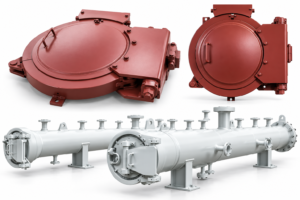

| PIPELINE PACKAGE SUPPORT Quick-opening closures for pig launchers and receivers, supported alongside piping, flanges and fittings. |
HORIZONTAL OR VERTICAL Orientation and opening arrangement selected to match equipment layout and site access. |
| SAFETY-FOCUSED DESIGN Pressure-warning and interlocking features can be specified where supported by the approved design. |
PROJECT-SPECIFIC MATERIALS Material grades, seal compounds, coating and connection details selected to suit service conditions. |
A quick-opening closure (QOC) is a pressure-containing access closure fitted to equipment that requires periodic entry for pigging, inspection, cleaning or maintenance. It is commonly used on pipeline pig launchers and receivers, filters, strainers and selected pressure vessels. The closure allows access without removing a conventional bolted blind flange, while its locking and sealing arrangement must be engineered for the specified pressure and temperature.
Depending on size and duty, designs may use a segmented locking ring, clamp or yoke arrangement. The selected design may be configured for horizontal or vertical installation and may include a hinge or door-support mechanism. Design details and operating steps vary by manufacturer and model.
| Industry / Equipment | Typical Application |
| Oil & Gas Pipelines | Pig launcher and receiver barrels on transmission, gathering and export pipelines. |
| Gas Processing & Compression | Access closures on selected filter vessels, separators and gas-processing equipment. |
| Refineries & Petrochemical Plants | Equipment requiring controlled access for inspection, cleaning and maintenance. |
| Storage Terminals & Tank Farms | Pipeline pigging systems and selected process equipment. |
| EPC & Pipeline Construction | New-build pipeline packages, modular skids, facility upgrades and replacement projects. |
| Industrial Process Facilities | Filters, strainers and pressure vessels where the selected closure design is suitable. |
Indicative selection ranges drawn from publicly available industry product literature. They are not a guarantee that every size, class, material and closure type is available in one design; the exact configuration must be confirmed.
| Parameter | Preliminary Selection Details |
| Nominal size | Reference product ranges commonly include approximately 6 in to 80 in and larger by engineered request; availability varies by model. |
| Pressure class | Class 150 to Class 2500 for selected segment-type designs; some clamp/yoke designs may have lower class limits. Confirm exact model. |
| Design codes / standards | As applicable to the selected equipment: ASME BPVC Section VIII, Division 1 or 2; ASME B31.3, B31.4 or B31.8 where applicable to the system and project. |
| Connections | Butt-weld ends or flanged ends, subject to design and line class. |
| Carbon / low-temperature steel | ASTM A105; ASTM A350 LF2; ASTM A694 grades such as F52, F60, F65 or F70 where appropriate to the design. |
| Stainless / duplex options | ASTM A182 F316L, F51 or F53 may be considered where compatible with the design and service. |
| Other pressure-part materials | Plate or other pressure-retaining materials to be specified by the approved design and material specification. |
| Sealing materials | NBR / Buna-N, HNBR, FKM / Viton, FFKM or EPDM may be evaluated for compatibility with the fluid, temperature and pressure. |
| Corrosion protection | Shop primer or customer-specified coating; stainless steel or Inconel 625 weld overlay may be considered where available and specified. |
| Orientation | Horizontal or vertical where permitted by the selected model and support arrangement. |
| Safety features | Pressure-warning device and mechanical interlock / sequential key interlock where provided and validated by the design. |
| Documentation | Drawings, material certificates, inspection and test records, code-stamp documentation and other deliverables as specified and available. |
Quick-opening closures are pressure-retaining devices. Opening a closure while pressure remains inside can cause severe injury or fatality. The closure must incorporate the safety features required by its applicable design code and purchase specification, and operators must follow the manufacturer’s approved operating and maintenance instructions.
To review your requirement and prepare a suitable technical and commercial proposal, please provide: